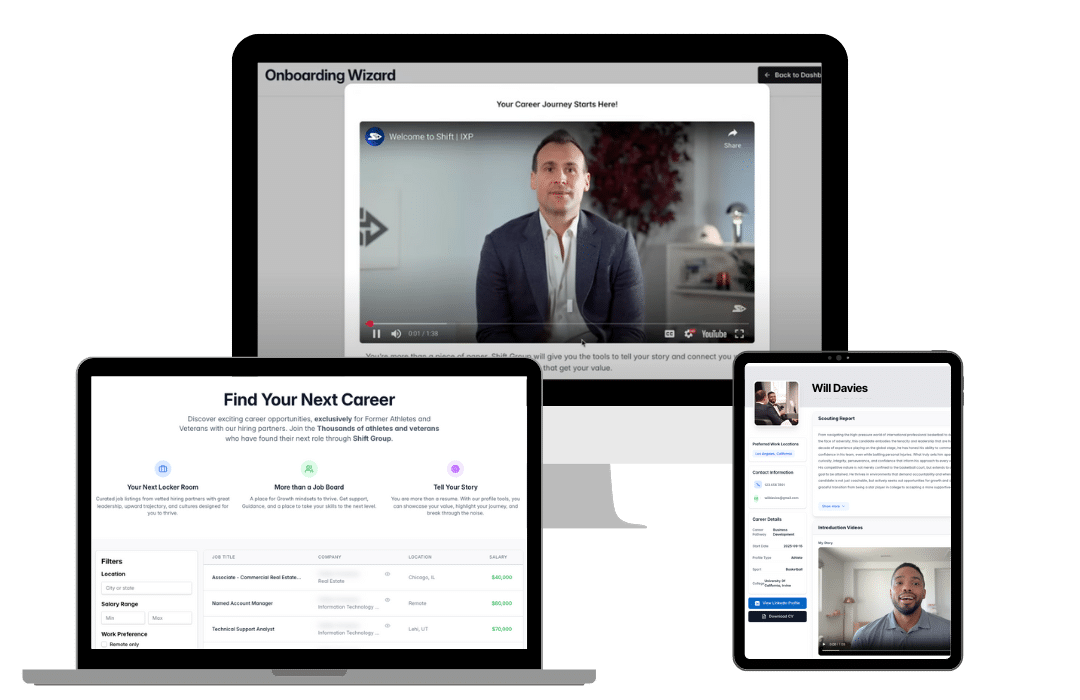
Shift Group's recruiting platform helps athletes and veterans transition into business careers. Their onboarding relied on an 11-question self-discovery questionnaire that powered an AI tool to generate personalized candidate profiles. But a lot of candidates were dropping off before completing it. The instinct was to cut questions. The problem was knowing which ones.
OBLSK came in to answer a specific question with evidence, not guesswork: which inputs actually drive the quality of the AI-generated output? Over five days, we ran six structured experiments, using large language models as both analytical tools and evaluators. The work produced both a recommendation and a repeatable methodology.
01
Challenge
- Candidates were abandoning the questionnaire before completion, blocking the AI tool from generating additional profile data
- Eleven open-ended prompts created significant friction before candidates could proceed
- Simply cutting questions based on instinct risked degrading the output. Shift Group needed evidence to justify changes to a core part of their product
02
Solution
- Designed and ran six LLM-powered experiments over five days, each informed by the results and limitations of the previous:
- Influence scoring: used ChatGPT as automated judges to score each question's impact on the scouting report, iterating from subjective 0–5 scoring to reliable binary scoring when early results proved inconsistent
- Question utility analysis: prompted the LLM to evaluate whether each question contributed unique insights or overlapped with other responses
- Reverse engineering: independently prompted the AI to work backward from completed scouting reports to identify the most essential questions, which converged on the same themes as the forward analysis
- Validation: generated additional profile data from the reduced four-question set and scored accuracy against full 11-question outputs using automated model-graded evaluation
03
Result
- Delivered a clear, reproducible answer to Shift Group's question about whether the questionnaire could be significantly reduced while still generating profile data of the same quality
- Reports generated from four inputs achieved 92% accuracy against the originals, representing a reduction of more than 60% in questionnaire length with no meaningful loss in output quality
- Proved that rigorous, evidence-backed experimentation doesn't require a quarter-long research engagement. We completed six experiments in five days, producing reproducible results
- Established a transferable methodology for any product where input complexity creates user friction, including lead qualification forms, intake workflows, product configurators, or any AI-driven process where you need to know which inputs actually matter